
We came in to write SEO articles.
A few months later, Sheetgo had made us its full-service team.
That change happened quickly because the first work exposed something much bigger than a search opportunity. Sheetgo had a powerful product, a growing business and a lot of intelligence inside the company. What it needed was a way to translate all of that complexity into communication that people could understand, trust and act on.
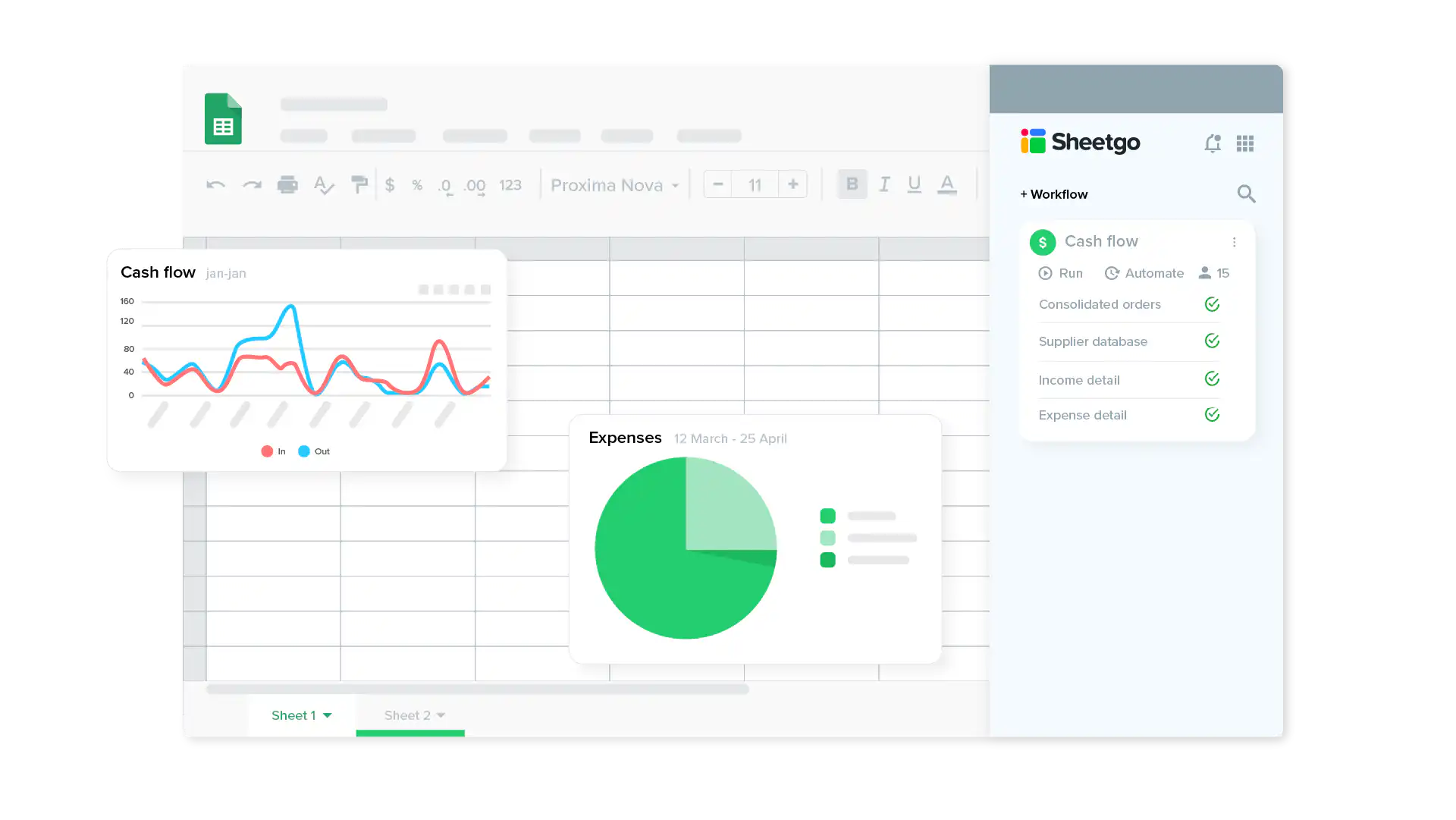
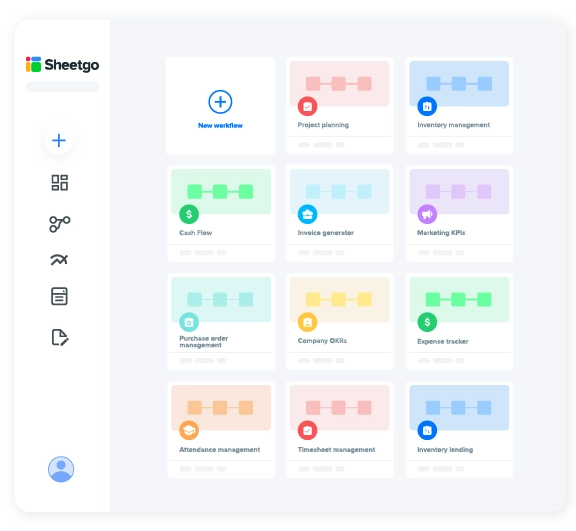
Sheetgo is an automation platform built around familiar tools such as Google Sheets and Excel. That familiarity is part of its strength. Underneath it sits a much more sophisticated product: workflows, connections, integrations, filters, templates, schedules and automation logic that can remove a huge amount of manual work.
The product could be complex.
The experience of understanding it could not be.
That became the thread running through almost everything we did for the next few years.
What started as SEO content grew into a much broader role across brand strategy, product, UX, web, marketing, sales, customer support and content. We helped define how Sheetgo spoke, how features and functionalities were named, how information was organised, how the website worked, how users moved through the product and how different teams explained the same thing without slowly creating different versions of the brand.
The point was never to make Sheetgo sound simpler than it was.
It was to make a sophisticated product feel easy to understand without losing the sophistication behind it.
SEO opened the door. Understanding the customer changed the brief.
Our first work with Sheetgo was focused on organic search.
People were already looking for the problems the product solved: how to consolidate spreadsheet data, automate repetitive work, connect information between tools or make a recurring process less manual. They were not necessarily searching for Sheetgo by name.
So we started by creating SEO articles around those real questions.
The work performed well enough that the relationship expanded quickly, but the most valuable thing we gained from those first months was not simply traffic.
It was language.
Search showed us how customers described their problems before they learned Sheetgo’s own terminology. It showed us the difference between the way a product team might describe a capability and the way someone outside the company would search for the same outcome.
That insight became useful everywhere.
The blog itself evolved into a much broader content hub, with educational content designed to attract, explain and guide rather than simply rank. We produced technical guides, how-to content and product education that supported different stages of understanding, from someone discovering a spreadsheet problem for the first time to an existing user trying to build a more advanced workflow.
Over time, the content stopped being a separate marketing channel.
It became one of the places where Sheetgo learned how its customers thought.
The real challenge was building a language for a complex product
Once we were working across more of the business, it became obvious that clarity could not depend on good copy alone.
It needed a language system.
We helped develop the verbal strategy behind the brand, including the proposition that became “Work made simple”.
That line mattered because it described the value of the product rather than its mechanics. Sheetgo could be technically capable without asking customers to absorb all of that technical capability before understanding why it mattered.
From there, the work went much deeper.
We defined terminology strategy across the product and wider communications: how features and functionalities should be named, which terms needed to remain fixed, how concepts should be grouped, how product language should relate to marketing language and how the content taxonomy should evolve as the platform grew.
These decisions can look microscopic from the outside.
Inside a growing SaaS product, they compound very quickly.
If a feature has one name in the interface, another on the website and another in the help centre, the customer has to work out whether they are looking at one thing or three. If navigation follows the company’s internal structure rather than the customer’s mental model, people struggle to find what they need before anyone has written a bad sentence. If naming changes informally as new capabilities are added, every future piece of content inherits the inconsistency.
So naming, taxonomy, content design and brand strategy became part of the same job.
We documented those decisions in the brand and content system, including the style guide, terminology guidance, messaging principles, user thinking, channel-specific guidance and the practical rules teams needed to keep communicating consistently.
That documentation mattered because Sheetgo was growing.
The goal was not for Bobs to become the only people capable of writing in the brand.
It was to make the thinking transferable.
Within months, we were working across Product, Marketing, Sales and Customer Service
The point where the relationship changed most was not when the service list became longer.
It was when the information started flowing across teams.
Within the first few months, we were no longer operating as an external content supplier. Sheetgo had brought us in as its full-service team, and our work crossed much of the organisation.
With Product, we worked on UX writing, content design, naming, terminology, taxonomy, onboarding, journeys and the language inside the interface.
With Marketing, we supported the content hub, website, campaigns, email, launches, brand communications and channels such as Product Hunt.
With Customer Service, we worked with help and support content and could see where users were repeatedly getting stuck or asking the same questions.
With Sales, we helped make the product easier to explain, connecting sophisticated capabilities to the concrete problems prospects were actually trying to solve.
The value was not simply having one agency available to four departments.
It was what happened between them.
A recurring support question could expose a product-language problem. Search data could reveal that prospects were using completely different terminology from the interface. A feature launch could require coordinated changes across product UX, the help centre, marketing, sales material and educational content. A Product Hunt launch could draw on the same positioning and product knowledge rather than becoming a one-off campaign disconnected from everything around it.
Context stopped getting lost at the handover.
That is where becoming embedded added the most value.
We did not have to rediscover Sheetgo every time a new brief arrived. We understood the mission, the product, the audiences and the reasoning behind previous decisions well enough to carry them into the next problem.
The knowledge accumulated.
The website was where brand, UX and product understanding finally met
By the time Sheetgo began rebuilding its website, we were not approaching it as writers waiting for a design.
We already knew the product from the inside.
We understood the language customers used in search, the questions appearing in educational and support content, the terminology inside the product, the brand voice and many of the places where users needed more clarity.
So we worked on the website as a complete content and UX problem.
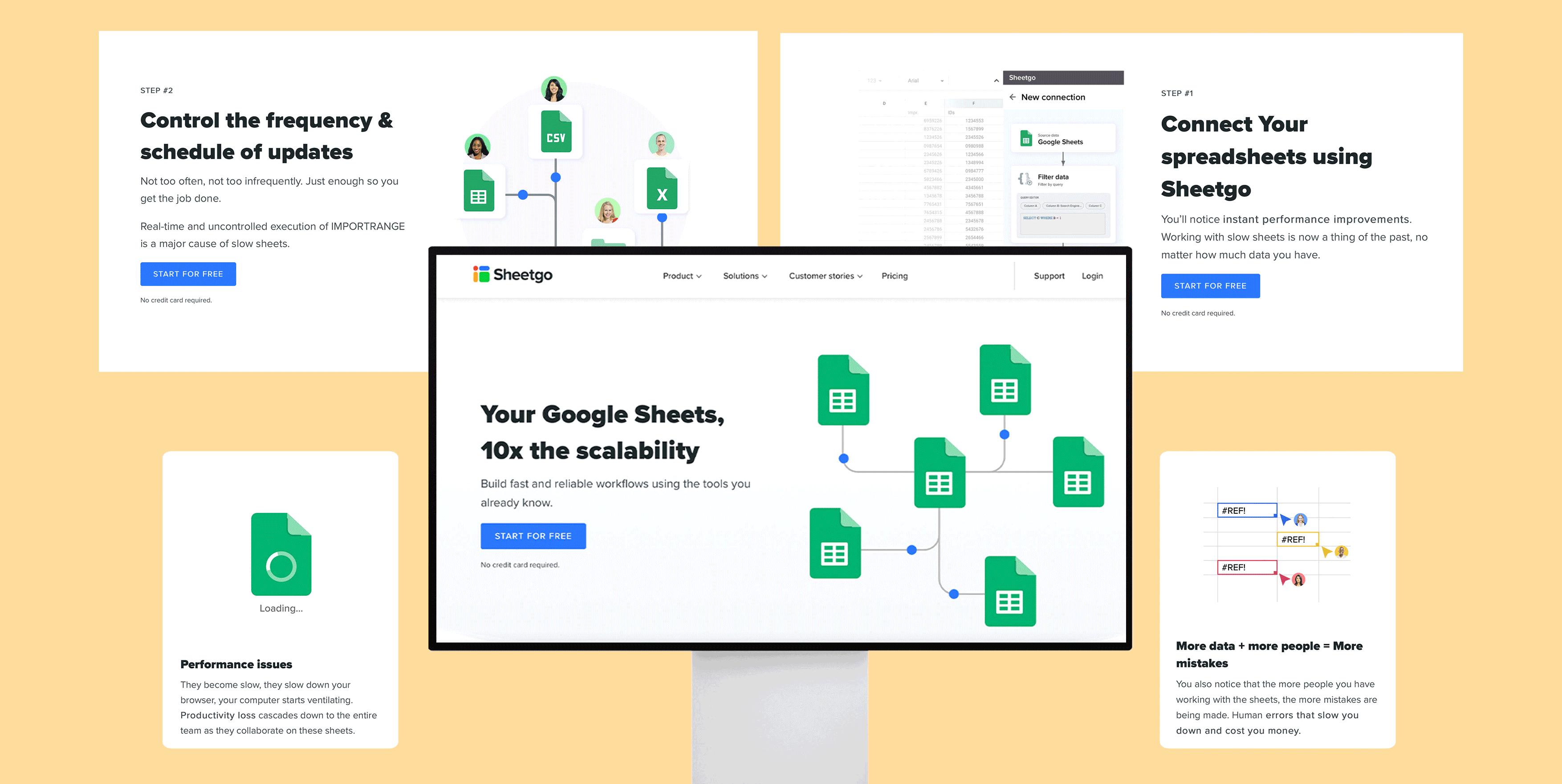
We created the information architecture, shaping the site around how customers understood their needs rather than simply reproducing Sheetgo’s internal product structure. We developed wireframes to define hierarchy and journeys before the final copy was written. Then we created the website content itself.
Because the strategy, structure and language were being developed together, they could challenge one another.
A page could change shape because the content revealed that two ideas should not live together. A product term could be reconsidered because search and customer-support language showed us that people understood the concept differently. A journey could become shorter because the hierarchy made the next step clearer.
We also audited and supported the product from a UX writing and content design perspective, so the promise made on the website did not collapse once someone entered the app.
“Work made simple” could not just be a slogan.
The product had to feel like it.
Then came a coincidence no strategy deck could have planned
There was another chapter in the Sheetgo story that none of us could have designed in advance.
Completely independently, Bobs was also the content team for Layer.
For almost a year and a half, we had taken care of Layer’s entire blog and turned it into a substantial organic content engine. We produced more than 225 articles across spreadsheet, finance, operations and automation topics.
The results were significant.
Twelve articles reached the number-one position on Google. A total of 146 ranked in the top 10, representing around 65% of the articles produced. And the ten strongest posts alone were bringing in more than 35,000 organic visits per month during the collaboration.
Then, by complete coincidence, Sheetgo acquired Layer.
We had spent years working with two separate automation companies, helping each of them explain complex products and build organic visibility, and suddenly they belonged to the same business.
What Sheetgo did next is particularly interesting from a content perspective.
Rather than simply absorbing Layer and switching off the old brand, it kept the Layer blog and branding alive so the content could continue attracting the traffic and authority it had accumulated.
That decision says something important about what a mature content library can become.
A strong blog is not just a stream of campaigns that vanish when the publishing calendar stops. Over time, it can become a durable acquisition asset with its own rankings, audience and accumulated value.
The Layer acquisition was not caused by our content work, and we would never claim that it was.
The interesting part is what happened after the acquisition: the content had enough continuing value that it was worth preserving.
The relationship had to grow because Sheetgo was growing too
Over the years we worked together, Sheetgo went through several stages of growth.
The company raised a $2 million investment from Bewater Funds, was selected as one of the Recommended for Google Workspace apps in 2022 and again the following year, expanded its customer base and add-on downloads, and eventually acquired Layer. The historical project materials record client-base growth of around 15% during the collaboration, while add-on downloads crossed the 4 million mark — adding more than half a million downloads from a starting point of roughly 3.5 million.
Those are Sheetgo’s business outcomes, created by the wider company and product teams. They should not be attributed to content, UX or Bobs in isolation.
What matters for this story is that our role had to keep evolving alongside that growth.
A communication system that works for a smaller SaaS company can begin to crack as the product expands. Terminology becomes harder to control. New features create more naming decisions. Acquisitions introduce another layer of product and brand complexity. More people are writing, selling, supporting and explaining the product.
Because we were already embedded, we could help Sheetgo adapt without rebuilding the communication from zero every time the company changed.
The style guide, terminology system, taxonomy, UX principles, website architecture and shared product knowledge became more valuable as the business became more complex.
Growth creates more things to explain.
A strong system stops every new thing from requiring a completely new explanation.
The best embedded teams do more than deliver work
Our relationship with Sheetgo lasted for years.
Eventually, the company reached the point where it made sense to build more of this capability internally and hire its own team.
We see that as a successful outcome.
A good embedded agency should create momentum and capability, not permanent dependency.
By then, the important knowledge did not only live in individual Bobs team members or Slack conversations. The brand strategy, terminology, taxonomy, style guidance, website logic and content principles had been turned into systems that other people could use and develop.
That is what makes the Sheetgo relationship such a good example of the kind of work we want Bobs to do.
We entered through one very specific need: SEO articles.
Within months, Sheetgo saw that the value went much further and made us its full-service team.
From there, we helped turn the blog into a content hub, define the brand voice and “Work made simple”, create the language architecture behind the product, support Product, Marketing, Customer Service and Sales, improve UX and content design, build the information architecture and wireframes for the new website, write the website itself, support launches such as Product Hunt, and carry the same thinking across the many places customers encountered the company.
Then we stayed long enough to see the business scale, raise investment, acquire another company we happened to know extremely well, and eventually build the internal capability to carry the work forward.
Full service was never the opening pitch.
It was what happened when understanding the business deeply enough made us useful almost everywhere.
Written by Bobs Agency
Talk it through with Bobs