

A customer sees an Instagram post, clicks an ad, visits a website, opens an account, receives an email, uses the app and gets a push notification.
Inside the company, that journey may have passed through half a dozen teams.
To the customer, it has passed through one brand.
And that's where things get interesting.
Brand consistency across marketing and product isn't about making everything sound the same. It's about making every interaction feel like it belongs to the same brand, even when its purpose, format and audience change.
It's a challenge we experienced firsthand during our collaboration with Wio Bank, a digital challenger bank based in the UAE.
Our partnership began around Wio's rebrand in 2024, when we teamed up with creative agency sstil (formerly minimum.run), which led design and motion while we took care of Wio's content needs.
But the work went far beyond the rebrand.
For more than a year, across 2024 and 2025, we worked as an embedded extension of Wio's internal team, supporting its evolving content needs across brand, marketing and product.
From developing content for the entire new website to creative campaigns, social media, paid ads, video and radio scripts, email marketing, customer communications and UX writing for new products such as Wio Family, our involvement spanned almost every kind of conversation a digital bank has with its customers.
Very different challenges. Different audiences. Different formats.
Yet all connected by the same ambition: making Wio distinctive, engaging and recognisable while keeping its communication clear, intuitive and genuinely useful.
One brand, many different conversations
Wio isn't your traditional bank. Its digital-first approach and challenger mindset call for communication that feels fresh, confident and willing to do things differently.
But being different isn't enough. Especially when you're talking about people's money.
A financial brand can be bold and playful, but it also needs to communicate with absolute clarity when customers are making decisions, managing accounts or navigating unfamiliar products.
That balance was central to our work.
Working alongside Wio's internal team meant moving between very different content challenges, often with entirely different objectives.
One brief might involve developing a creative campaign to introduce a new offer. Another could be about finding the clearest way to explain a financial feature on the website, writing an onboarding journey or making a push notification feel helpful rather than intrusive.
Each required a different approach.
And because we worked across so many touchpoints over an extended period, we could build on our understanding of Wio's positioning, products and customers rather than treating every assignment as an isolated piece of copy.
That continuity matters.
A brand voice becomes genuinely valuable when it can guide hundreds of different decisions without making every message sound identical.
A consistent brand voice shouldn't sound exactly the same everywhere
This is where tone-of-voice work can become slightly dangerous.
Define a voice too rigidly and suddenly every channel begins to sound as though it's being written by the same person in exactly the same mood.
That's not consistency.
It's monotony.
A radio ad needs to earn attention in seconds. A social campaign can be playful, surprising or deliberately provocative. A promotional email has room to build anticipation.
An onboarding message, on the other hand, needs to help someone move forward. And when a user is dealing with a payment, a financial decision or an error message, personality should never compete with clarity.
Wio brought that tension into sharp focus.
As a challenger brand, it had room to challenge conventions and communicate with confidence. As a bank, it needed to make financial information understandable, credible and reassuring.
The secret isn't choosing between creativity and clarity. It's knowing when each should lead.
That's how we approached Wio's communication across channels: maintaining the personality and underlying principles of its brand voice while adapting the expression to the purpose of each interaction.
The voice remained recognisable. The delivery changed to suit the moment.
The new website: where brand strategy, verbal identity and user experience meet
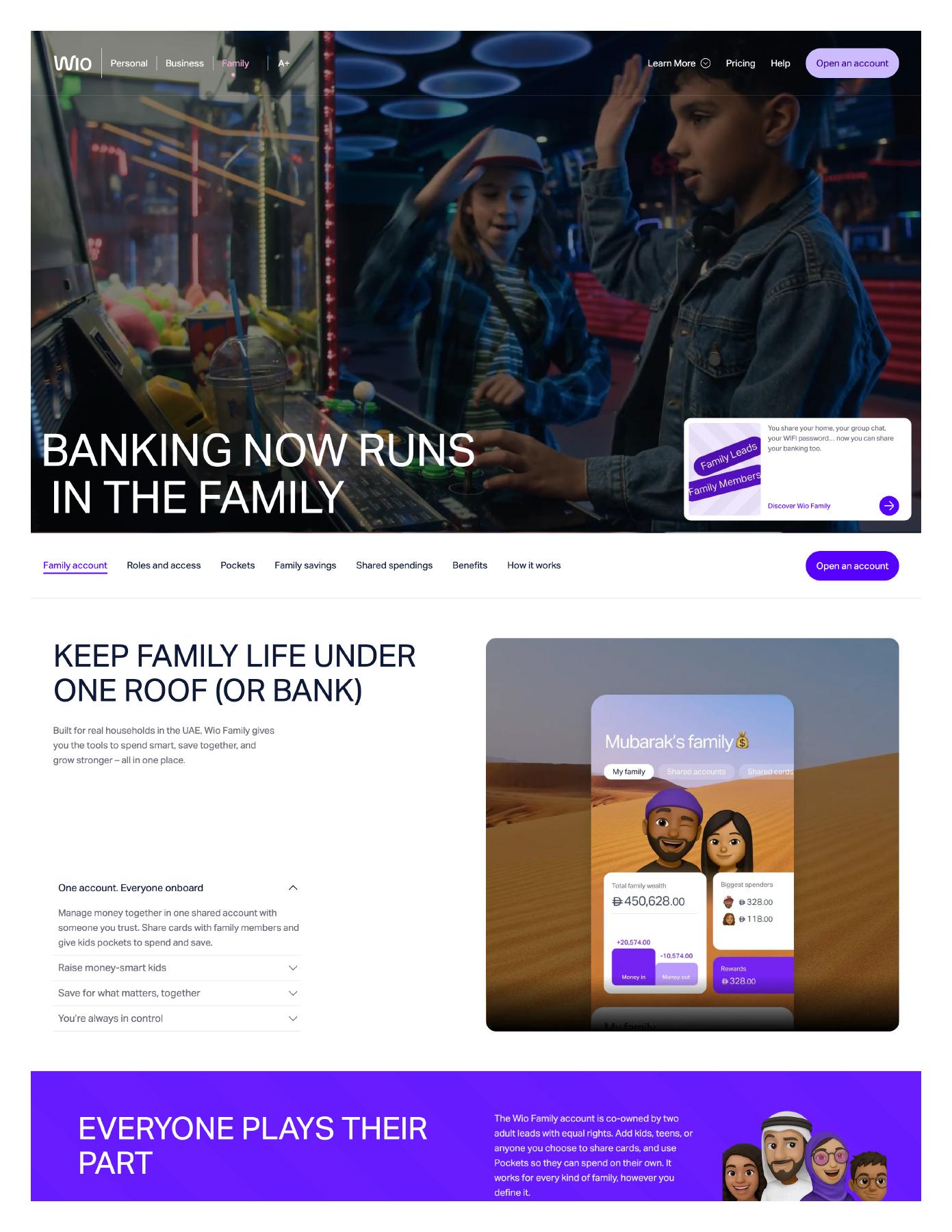
One of the first major projects during our collaboration was developing the content for Wio's entire new website, alongside the rollout of its refreshed brand identity.
A website is an interesting test of a verbal identity because it has to achieve several things at once.
It needs to express the brand's personality, communicate its positioning, explain the products, differentiate the offering and guide people towards meaningful actions.
And it has to do all of that without making visitors work unnecessarily hard to understand what they're looking at.
For Wio, this meant bringing the new tone of voice and verbal identity into the website experience while making its banking products and features clear, relevant and benefit-led.
We worked on the messaging across the site, balancing brand expression with the practical information users needed to understand Wio's offering.
Some moments called for confidence and personality. Others needed direct, straightforward explanations.
The challenge was finding the right balance so that the writing felt distinctive without becoming distracting, and simple without becoming generic.
Working alongside sstil, which was responsible for design and motion, also meant that content and visual expression could work together as complementary parts of the same experience.
Because the best website content isn't just copy that fits into a design. It's part of what makes the design work.
Creativity works harder when it's grounded in strategy
Throughout our collaboration, we also supported Wio's ongoing creative and marketing activity, developing campaign concepts and content across social media, paid advertising, video, radio, email, events and customer communications.
Each format presented a different creative challenge.
A video can build a narrative through visual storytelling. A radio script has to create an impression without visuals. A paid ad may have only a few words to communicate the value of an offer. Social content needs to capture attention while remaining relevant to the audience and recognisable as the brand.
And then there are product launches, promotions and educational content, where the message has to be compelling enough to generate interest and clear enough to explain what's actually being offered.
Creative content isn't simply about finding a clever headline or an unexpected way to say something.
The strongest creative ideas make a brand more distinctive while making its message easier to understand, remember or act on.
Take a few examples from our Wio Credit campaign work.
To communicate flexible instalment payments, we developed messaging such as "Keep the peace, pay piece by piece", connecting a playful expression with the practical benefit of spreading purchases over time.
For shopping-related cashback, "Add to cart, add to wallet" linked an everyday behaviour to the financial benefit of the product.
And for Wio Business Credit, "Business spends that pay you back" turned a cashback proposition into a direct, memorable benefit for business owners.


Different propositions, different audiences and different creative approaches. But the same underlying thinking: make the benefit immediate, communicate in language people recognise and give the brand a distinctive personality.
The headline earns attention. The supporting copy makes the proposition clear.
We also explored more conceptual storytelling for functional communications. One security-awareness video concept, for example, used the familiar structure of an airline safety briefing to explain banking security features through a more engaging narrative.
It's an example of how creativity can make even practical, information-heavy subjects more accessible.
For Wio, the objective wasn't to make every communication clever. It was to find the right idea for each message while remaining useful, credible and recognisably on-brand.
Creative freedom and strategic discipline aren't opposites. The best work needs both.
The voice, in motion
Original campaign work. Offers shown reflect the materials supplied, not current banking terms.
Speaking the user's language is a product decision, not just a writing preference
Marketing can frame the promise. The product has to deliver on it.
If a campaign makes managing money sound simple and intuitive, the app needs to continue that experience.
If the marketing feels friendly and direct but the product suddenly becomes dense or bureaucratic, users will believe the product.
This is particularly important in financial services, where unfamiliar terminology can make an otherwise useful feature feel unnecessarily complicated.
The challenge isn't to remove every technical term or simplify information at the expense of accuracy.
It's to understand what people actually need to know, find the clearest way to explain it and organise information around their goals rather than the company's internal terminology.
A good feature name should communicate something meaningful before the user reads the explanation beneath it.
A useful notification should make its purpose clear immediately.
And effective UX writing should help people understand what they can do, what happens next and why it matters.
This is where content moves beyond communication and starts shaping the experience itself.
Wio Family: when content becomes part of the product
One of the clearest examples from our collaboration was our involvement in Wio Family, a new family banking solution launched in 2025.
Our work went beyond creating the communications to promote the launch.
Working closely with the product and design teams, we contributed to defining product features and naming conventions, supported improvements to user flows and developed UX writing across the app experience.
We also worked on the communications surrounding the product, including in-app messages, push notifications and transactional emails, helping connect the experience inside the app with the wider brand.
The onboarding experience is a good illustration of how those decisions come together.
It needed to introduce unfamiliar shared-banking functionality in a way that felt intuitive, approachable and relevant to different kinds of families.
Rather than simply listing product features, the content connected functionality with recognisable needs: managing money together, giving family members appropriate independence, building better financial habits and working towards shared goals.
Messages such as "Shared accounts, personal cards, one connected view" expressed a relatively complex proposition in language designed to be easy to understand.
Other moments could be warmer and more expressive, while instructions and functional interactions needed to remain precise.
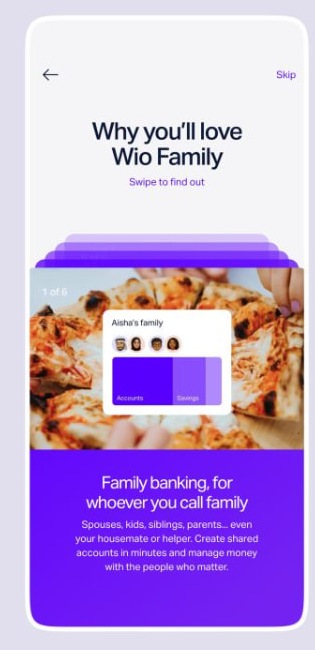
Family banking, for whoever you call family
Product language connects shared-banking features with familiar needs. Personality opens the conversation; precise instructions help people move forward.
Wio Family onboarding — connecting shared-banking features with everyday family needs.
Why does that distinction matter?
Because language can influence how a product is understood long before a user starts reading the instructions.
A feature name sets expectations. The way information is organised affects how easily someone understands an option. A button label helps communicate what will happen next.
And if those decisions aren't considered together, even a thoughtfully designed product can become harder to navigate.
Naming, content hierarchy and UX writing therefore aren't simply finishing touches. They're part of how a product communicates its functionality and value.
For Wio Family, our involvement connected those product-level decisions with the wider brand experience.
That's the kind of work that sits between brand strategy, content design and UX, rather than belonging neatly to just one discipline.
And it's often where thoughtful content work makes the greatest difference.
Different teams need more than the same tone-of-voice PDF
Brand inconsistency is often visible in the writing. But the problem can start much earlier.
Different teams naturally hold different pieces of information.
Product understands the functionality. Marketing knows the positioning and campaign objectives. CRM understands the customer relationship. Social is closer to the conversations happening around the brand.
When those teams work independently, language can drift because the underlying context has drifted first.
This is one of the advantages of working as an embedded content partner rather than approaching each brief in isolation.
During our time with Wio, our involvement across brand, marketing and product allowed us to carry knowledge and context from one challenge into the next.
A product naming decision could inform the language used in a campaign. A marketing promise could be checked against what the user would actually experience in the app. The product experience could reveal where a broader brand message needed more clarity.
And as new campaigns, features and communications emerged, we could apply the same understanding of the brand while adapting to each team's needs.
That doesn't mean one central team should control every word.
Growing brands need enough freedom to work quickly, experiment and respond to different audiences.
But the thinking behind important decisions has to travel across teams if the output is expected to feel connected.
Growth, innovation and industry recognition
During our collaboration in 2024 and 2025, Wio continued expanding its product ecosystem, introducing offerings including Wio Family and Wio Wealth alongside its ongoing marketing and communications activity.
Over a period of months, Wio's Instagram community also grew from approximately 16,000 to more than 21,000 followers.
That growth was part of a much broader business and marketing effort, not something that can be attributed to content or creative work alone.
But it illustrates the pace at which the brand was evolving, reaching new audiences and communicating increasingly diverse products.
Wio's progress also earned recognition across the banking industry.
The bank was named Digital Bank of the Year at the E-Business Awards 2024. In 2025, it received Best Innovation in User Experience at the MEA Finance Banking Technology Awards, was recognised by Euromoney as the Middle East's Best Digital Bank, and earned Silver in the Business Banking category at the Qorus Reinvention Awards MEA.
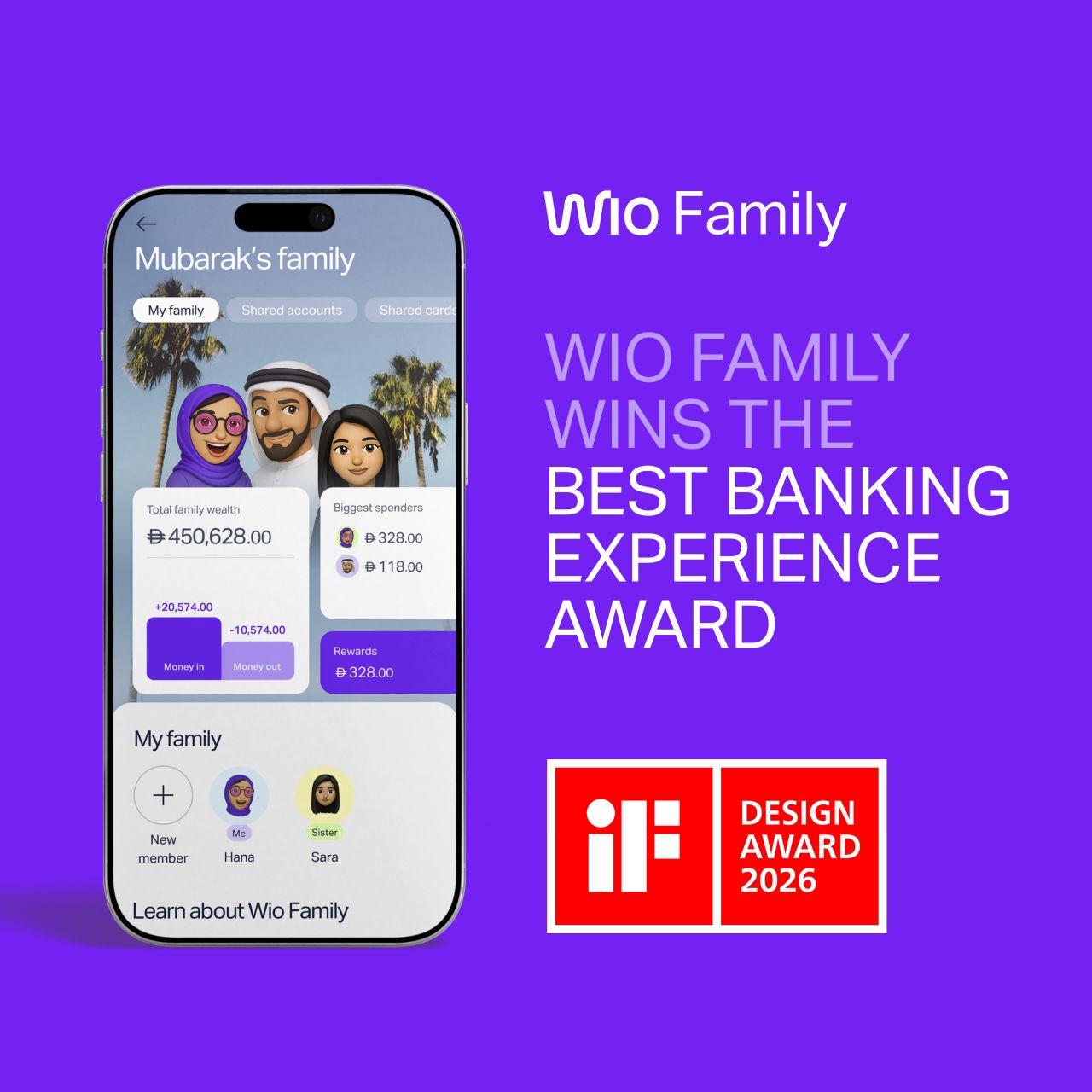
The recognition continued after our collaboration. In 2026, Wio received Best Digital Bank for SMEs at the MENA Banking Excellence Awards, while Wio Family was recognised with an iF Design Award 2026 for its banking app experience.
These were Wio's achievements, reflecting the collective work of its internal teams and wider ecosystem of partners across technology, product, design, customer experience and marketing.
We're proud to have contributed to that wider effort through our work on the brand's content, creative communications and digital product experiences during a significant period of its growth.
And that evolution reinforces an important point.
Every new product creates new terminology. Every new campaign adds another expression of the brand. Every new customer journey introduces situations that existing guidelines may not have anticipated.
At that point, consistency can't depend on everyone remembering the right adjectives from a workshop six months earlier.
It needs to come from a shared understanding of the brand, its products, its audience and the decisions that matter most.
This is becoming even more relevant as AI enters everyday content workflows.
Generative tools can imitate a writing style quickly, but they can't reliably infer product context, strategic priorities or the reasoning behind decisions they haven't been given.
Without that context, producing more content can simply mean producing more inconsistency.
The same principles that align human teams also make AI-assisted content more dependable: clear positioning, purposeful language, shared terminology and a strong understanding of the product.
So how do you keep brand voice consistent across marketing and product?
Our experience with Wio reinforced an important principle:
Consistency is a way of making decisions, not a way of making every sentence sound alike.
For any brand evolving across multiple channels and products, three questions are worth asking:
- What makes this recognisably our brand? The point of view, personality and messaging that should remain consistent even when the tone changes.
- What does the user need in this particular moment? Attention, reassurance, understanding, confidence or a clear next step. Each demands a different approach.
- Does the communication match the actual experience? The promise made in marketing should be reflected in the language, functionality and interactions people encounter in the product.
The answers don't always come from the same discipline.
That's precisely why connecting creativity, strategy, content and product thinking matters.
For us, working as part of Wio's extended team over more than a year meant doing exactly that. Moving between a new website, ongoing marketing campaigns, customer communications and digital product experiences, while helping maintain a coherent voice across them all.
Not by making everything sound the same, but by understanding what made each interaction different and what needed to remain consistent.
Ultimately, customers will never know how many people, teams or disciplines contributed to their experience of Wio.
And that's fine.
The work is doing its job when it feels like they didn't.
Written by Bobs Agency
Talk it through with Bobs